

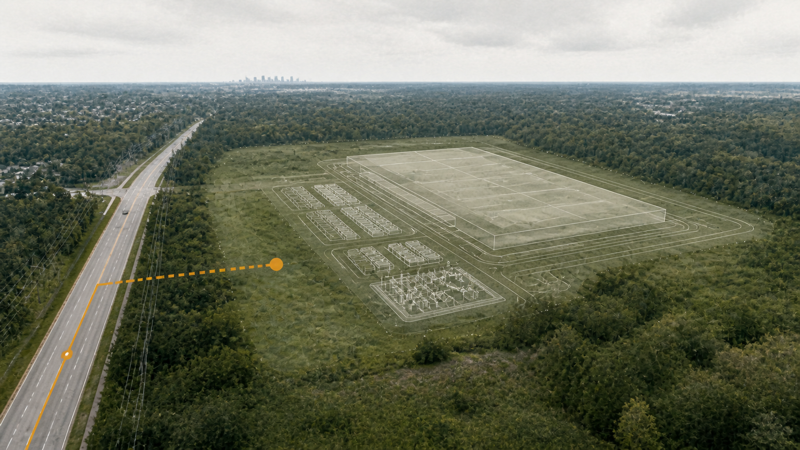
The applicant withdrew a request tied to a proposed southeast Raleigh data center whose current developer or buyer has not been publicly identified. Public opposition preceded the withdrawal, but Raleigh did not reject the facility and the record does not establish that development on the site has ended.
The case, AX-09-26, concerned 13.646 acres at 3101 Jones Sausage Road. The petition signed March 11 requested Raleigh water and sewer service, projected 99,345 square feet of nonresidential construction and listed an estimated completed market value of $180 million. The form’s specific-use field says “Office,” while the attached survey identifies the project as the Jones Sausage Road Data Center.
A withdrawal with an unresolved project sponsor
Reporting places the withdrawal on Aug. 14, before the scheduled Aug. 18 council meeting. Raleigh announced it Aug. 15. Mitchell Silver, the District A council member, publicly communicated that the application had been withdrawn following substantial opposition.
The filing identifies B3-SFRE JSR LLC as the property owner and gives a Beacon Partners contact. Early public descriptions treated Beacon as the developer. WUNC corrected that account after Walker Gorham, managing partner at Beacon Partners, said Beacon owned the parcel but had been under contract to sell it since 2025 and had no role in or visibility into the current proposal.
That correction changes the responsible description of the case. Beacon is the parcel owner associated with the filing, not a verified project developer. The public material reviewed does not confidently identify the buyer, developer or entity that chose to withdraw. Calling Beacon the developer would assign an action that the available reporting directly disputes.
Annexation is not the same as development approval
Raleigh’s annexation process concerns municipal boundaries and access to city services. The request sought water and sewer, but withdrawal did not amount to a council vote on a final site plan, building permit or special-use permit. It also did not create a citywide moratorium or prevent a different application from being filed.
Secondary reporting described the proposed facility as having about 12 megawatts of critical load. The petition itself does not provide a detailed power specification, cooling design, water-demand estimate, generator plan, acoustic study or traffic analysis. The $180 million figure is a projected completed market value, not money already invested or a verified project cost.
Opponents raised concerns about power, water, noise, backup generation and the lack of Raleigh-specific data-center rules. Hundreds of residents reportedly submitted comments, and dozens signed up to speak. Those actions help explain the political conditions surrounding withdrawal. They do not reveal why the request was withdrawn or prove that opposition alone caused the decision.
The site question remains open
The next evidence should identify the purchaser under contract, whether that contract remains active and what development rights exist under Wake County jurisdiction without annexation. Utility records could show whether the project had requested electrical service. A revised annexation filing, rezoning application or county permit would indicate whether the plan had changed rather than disappeared.
Technical review would also need the project’s actual load, cooling system, water consumption, emergency generators, emissions, noise model and construction traffic. None of those impacts can be responsibly inferred from the square footage alone. The petition established a proposed building scale and service request, not the facility’s operating consequences.
The projected tax value also needs context. A $180 million completed market value could enlarge Raleigh’s tax base if the project were built and annexed, but it does not state the annual property-tax payment, incentive package or net public revenue after service costs. Data centers often generate substantial taxable equipment value with relatively few permanent jobs. This filing does not provide employment estimates, wage commitments or an economic-impact analysis, so neither the tax benefit nor the job criticism can be quantified from it.
Withdrawal before a hearing also prevents a formal evidentiary record from developing. Council members did not have to make findings, attach conditions or state how they interpreted Raleigh’s existing rules. That leaves opponents without a precedent and proponents without an approval standard. A future applicant could return with different cooling, backup-power or site terms and present a materially different case.
Raleigh’s annexation-case registry remains the primary place to check whether AX-09-26 is replaced by a new application.
The withdrawal is still a meaningful local political signal. A data-center annexation that might once have received routine infrastructure review became a contested public issue and left the council agenda before a vote. The outcome is procedural and temporary. Raleigh residents changed the immediate decision context, while the developer’s identity and the site’s future remain unanswered.