
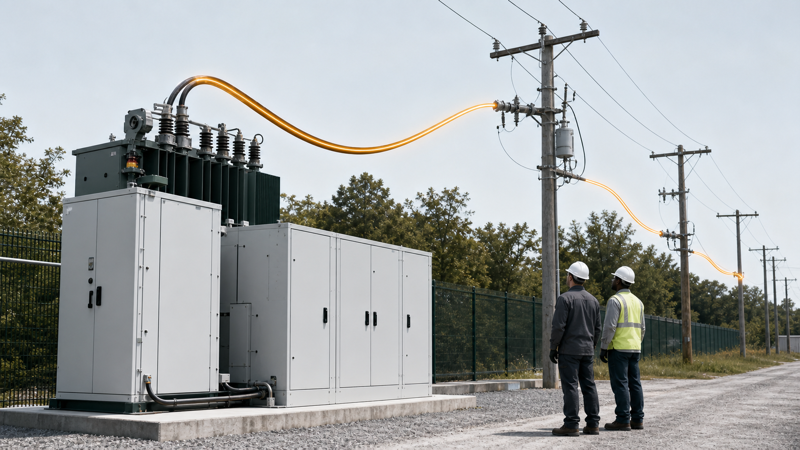
NC State researchers have moved a one-megawatt solid-state transformer from university development onto a live distribution feeder at an independent test facility. The field demonstration is a meaningful step beyond a laboratory prototype. It does not establish commercial readiness, utility certification or the long-term reliability needed for grid deployment.
NC State announced Aug. 18 that the containerized unit had operated at EPRI’s Lenox, Massachusetts facility. The system arrived in May and was expected to remain through September. The New York Power Authority funded construction and field testing, while EPRI hosted and monitored the work.
Full-scale power conversion under real conditions
A conventional distribution transformer changes voltage using magnetic components, while many modern loads also require separate power electronics to convert alternating current to direct current. A solid-state transformer combines power conversion, control and isolation in a more configurable system. Potential uses include electric-vehicle charging, renewable generation, microgrids and data centers.
The one-megawatt rating matters because it puts the prototype at a scale relevant to commercial charging and power-distribution equipment. It does not mean the device served a commercial customer or operated as a permanent part of a utility network. A supervised feeder test at a research facility is a demonstration environment, even when the electrical conditions are real.
Srdjan Lukic, the Lampe Distinguished Professor of Electrical and Computer Engineering and deputy director of NC State’s FREEDM Systems Center, is the principal investigator. NYPA project lead Ramadan Elmoudi managed the utility side of the demonstration. Drew McGuire, EPRI’s senior director of transmission and distribution research, supervised the EPRI test work.
NC State credits doctoral candidate Oscar Montes and students Nazmul Hassan and David Dadzie with helping design, construct and test the prototype. The public project account does not specify Hassan’s or Dadzie’s current degree status, so they should be identified simply as NC State students.
Efficiency and priority claims need the test report
NC State reports roughly 98% conversion efficiency, compared with about 96% for a conventional transformer plus rectifier. A two-percentage-point improvement at megawatt scale could reduce heat and operating losses in a continuously used conversion stage. It does not cut all electricity-system losses in half, because generation, transmission, cooling and downstream equipment remain outside that comparison.
Lukic also describes the test as the first independently verified megawatt-class modular medium-voltage solid-state transformer under real-world conditions. EPRI’s participation gives the demonstration more independence than a test run only by the inventors. No public EPRI report reviewed for this story provides the protocol, measurements or basis for the “first” claim. Until that record is available, the priority and efficiency figures should be attributed to NC State.
The project began with support from the U.S. Department of Energy under award DE-EE0008450. A technical paper documents the design lineage, while the Lenox test adds evidence at equipment scale. Neither source answers the commercial questions.
Reliability is the harder test
Utilities buy equipment expected to survive years of changing loads, heat, faults, weather and maintenance constraints. A solid-state system can offer control and compactness while adding semiconductor components whose failure behavior, replacement cost and cybersecurity requirements differ from conventional transformers.
The next evidence should include the EPRI test protocol, load profile, temperature range, efficiency curve, fault events and operating hours. Buyers will also need equipment cost, service-life projections, repair procedures, safety certification and a comparison with the conventional transformer and rectifier that the system would replace.
Efficiency should be measured across the operating range, not only at a favorable load point. Data centers and charging stations change load over time, and power-electronic systems can perform differently at partial load. The public announcement gives a headline percentage but no curve, uncertainty range or duration. It also does not state whether auxiliary systems, controls and cooling are included in the measurement boundary.
Modularity could improve service by allowing a failed section to be isolated or replaced, but it could also create more components that need monitoring and spare parts. The test record should show whether the system continued operating during a module fault and how quickly technicians restored capacity. Those details would turn “modular” from a design description into an operational advantage.
The data center connection
The original DOE project focused on an intelligent, grid-friendly fast-charging system. NC State’s Aug. 18 account identifies data centers, microgrids and renewable integration as additional possible uses. Those are application prospects, not tested deployments. The Lenox demonstration establishes operation on a live feeder at one megawatt. It does not show integration with a data center, charging network or renewable plant.
The Aug. 18 result shows that an NC State prototype can operate at one megawatt on a live feeder in a supervised field test. That is a credible engineering milestone. Whether it is cheaper, more reliable or ready to power data centers and charging networks remains unproved.