
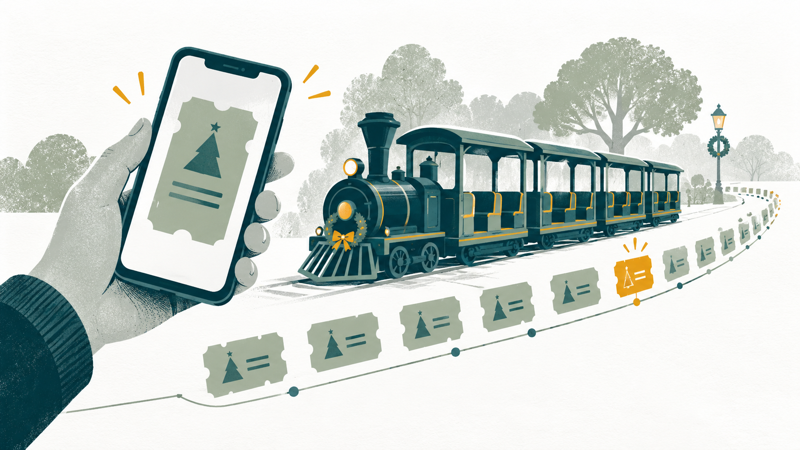
At Pullen Park, Raleigh’s Holiday Express is a ticketed holiday event built around the train, lights, carousel and other activities. The city charges $21 plus tax and fees, and a ticket covers event admission and activities, with a designated train-ride time. Every guest age 1 or older needs a ticket, including those who won’t ride the train. The city’s current page lists dates from Dec. 1 through 17.
That’s why Raleigh’s reported oversale matters. The News & Observer reported that nearly 2,200 Dec. 17 tickets were oversold, with the city planning to contact buyers about other dates, including an added Dec. 18 night. The most useful remedy is a usable replacement date or a full refund including fees. Public records checked Oct. 20 do not establish the cause or how many buyers have completed a remedy.
A ticket is a promise the city has to keep
The city is selling admission to an organized holiday outing, with train rides booked for specific times. Ticketing gives it a way to allocate those visits before people arrive. The practical requirement is straightforward: the bookings have to match the park experience and train slots available.
An oversale leaves buyers choosing between alternatives they did not book. A different night may mean missed work, child-care changes, travel adjustments or a lost chance to gather with relatives. Those constraints will not affect every ticket holder, but they are why “come another day” is not automatically the same product.
The N&O reports that the city was investigating the cause. The public evidence gap is about completed remedies; it does not prove that Raleigh has failed to contact buyers privately.
Matt Haikin’s account shows the repair burden
Matt Haikin described a different kind of ticketed-event failure in a September 23 personal account of the AI Summit Barcelona. He wrote that queues kept him from a workshop and that he eventually left. The event organizer’s current support page acknowledged access, wait and livestream problems, and promises an individual email response within 30 days. That is a process, not proof that refunds have been paid.
Haikin’s guess that AI helped plan the summit is explicitly speculation. Nothing in the Raleigh records checked establishes an AI cause. The useful comparison is simpler: when the promised experience breaks down, attendees carry the immediate burden of finding another plan, documenting what happened and seeking a fix. An organizer’s job is to make that repair easy rather than make every buyer negotiate it alone.
Each option has a cost
Moving buyers to another Holiday Express night preserves the outing for people who can use it. The reported Dec. 18 addition expands that choice. But neither helps a family that cannot shift work, child care or travel.
Raleigh could also keep the Dec. 17 visit available only if it can verify enough additional capacity to deliver the ticketed experience it sold. Any extra bookings would need enough train slots as well as room at the event.
The city’s ordinary policy also allows ticket transfers or resale, according to its Holiday Express information. That can help some buyers, but it shifts the work to them and offers no guarantee that they will find another buyer. It should not be Raleigh’s main answer to its own oversale.
A full refund, including fees, would let buyers who cannot use another date walk away without paying for the failed booking. It still cannot give them the outing they wanted. And the city’s ordinary terms say all sales are final and nonrefundable. Those terms do not settle what Raleigh should offer after its own oversale. Refunds here are my recommendation, not a verified existing policy or legal entitlement.
Raleigh should return the choice to ticket holders
Raleigh should give every affected buyer one city-run process with a clear contact method and deadline: choose a usable alternate date, if one is available, or receive a full refund including fees. Buyers should not have to bounce between the city and Ticketmaster to find out who owns their problem.
The city should report how many affected orders have been moved or refunded, while keeping orders distinct from the nearly 2,200 reported excess tickets. It should also test that online inventory matches available train slots and event capacity before the next sale, and explain the cause when it knows it. Ticketmaster’s involvement identifies the platform; it does not establish who caused the oversale. That would not erase the disruption. It would show that a ticket to a public holiday event is backed by a public process when the sale goes wrong.
Who should we know? Introduce us to someone making a consequential Triangle technology decision, or send a tip about what they are doing.