
Duke has retained a co-lead role in a national quantum-simulation institute renewed by the National Science Foundation for five years. The award is expected to total $37.5 million across a University of Maryland-led consortium. It is not a $37.5 million grant to Duke, and the renewal does not establish that the institute has achieved practical quantum advantage.
NSF announced the renewal Aug. 25, with the new award period effective Sept. 1. The Quantum Leap Challenge Institute for Robust Quantum Simulation began in 2021 with a $25 million federal award. University of Maryland anchors the institute; Duke and Princeton co-lead it.
A consortium award with a defined Duke role
Kenneth “Ken” Brown, the Michael J. Fitzpatrick Distinguished Professor of Electrical and Computer Engineering and director of the Duke Quantum Center, is Duke’s principal investigator. Crystal Noel, an assistant professor of electrical and computer engineering, is one of seven Duke faculty members affiliated with the institute and plans to conduct renewed-phase simulations on Duke processors.
The University of Maryland’s Aug. 25 announcement says Mohammad Hafezi, a Maryland professor with appointments in physics and electrical and computer engineering, will direct the renewed phase. Andrew Childs, who directed the institute through its first five years, is stepping down. The new award period begins Sept. 1, so the leadership change should be reported as an announced transition rather than a completed one.
The renewed consortium includes Maryland, Duke, Princeton, Yale and the National Institute of Standards and Technology, with Harvard joining. The Institute for Robust Quantum Simulation will continue work on verification, error mitigation and scalable simulations while adding research on interacting fermions, matter-force interactions and dissipative quantum systems.
What $37.5 million represents
The Duke announcement calls the five-year award an expected $37.5 million. That amount supports the consortium, not Duke alone. The public notices do not disclose Duke’s subaward, annual allocation or the amount assigned to its hardware, faculty, students and education programs.
NSF announced more than $290 million across eight Quantum Leap Challenge Institutes. Each will receive about $28 million to $37 million over five years, supporting researchers in 19 states at 36 higher-education institutions and partnerships with more than 30 companies. Those national totals should not be presented as Triangle investment.
Maryland reports that the institute’s first phase produced more than 600 papers, nearly 17,000 citations and training for more than 400 graduate students and postdoctoral researchers. These are consortium totals supplied by the lead institution. They do not identify Duke’s share, measure independent research quality or show that the work produced commercially useful quantum systems.
Renewal is evidence of merit
NSF merit review and a second five-year award indicate that the agency judged the collaboration worth continued support. That is a meaningful signal after the first funding cycle. Scientific funding decisions still differ from demonstrations that a quantum device solves an important problem better, faster or more cheaply than a classical alternative.
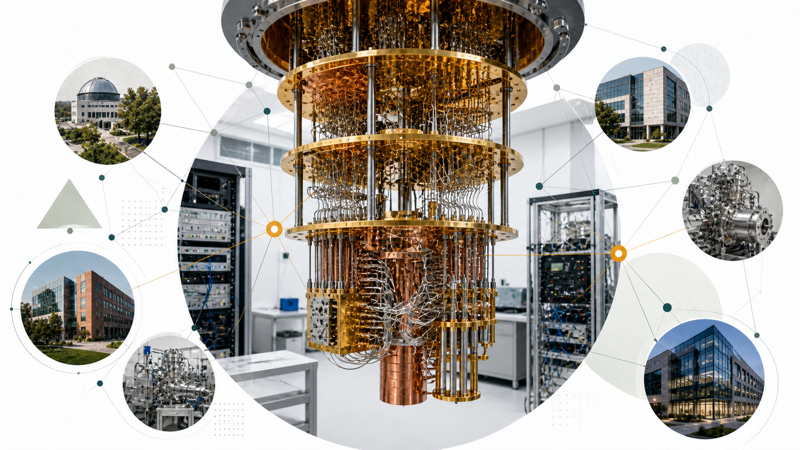
Quantum simulators are designed for specific physical systems rather than every computing task. Their hardware remains sensitive to noise and verification is difficult because the systems being simulated can exceed classical checking methods. Those constraints explain the institute’s focus on robust and verifiable simulation. They also make broad claims about practical quantum computing premature.
The renewal’s three technical themes narrow the claim. Interacting fermion simulations address particles that make up matter. Fermion-boson simulations examine how matter particles interact with force-carrying particles. Dissipative simulations study systems interacting with their environments instead of treating every environmental effect only as unwanted noise. Progress in any one theme would be a scientific result, not evidence that quantum machines outperform classical systems generally.
More than just quantum computing
The institute also funds education and workforce activity. Maryland says the first phase supported teacher workshops and classroom materials alongside graduate training. Those outputs can broaden technical capacity even if hardware milestones take longer. They should be measured through participation, completion and subsequent research or employment rather than folded into publication counts.
Harvard’s addition expands the research network, while continuing participation by NIST gives the consortium access to federal measurement expertise. Neither fact identifies a commercial partner, a deployment customer or a product schedule. The renewed institute remains a research collaboration whose stated purpose includes scientific and workforce development.
The next phase should produce clear milestones for Duke’s ion-trap systems, comparisons with classical methods, error and verification results, and public evidence of which simulations create new scientific knowledge. The consortium should also disclose Duke’s funding share, industry terms and any intellectual-property arrangements relevant to commercialization.
Duke’s August result is sustained institutional positioning in a major federal research network. The university remains a co-leader with equipment and faculty assigned to the work. The money is shared, the next phase had not begun when announced and practical advantage remains the standard the research still has to meet.