
The Research Triangle is confirmed as the host site for a high-level G20 technology ministerial in Chapel Hill. Yet the official records reviewed on Aug. 31 do not identify a Triangle university, company, local government or civic organization as a participant in the AI policy work.
That is the useful local question around the Sept. 1–2 meeting at the Carolina Inn: is the Triangle shaping G20 AI policy, or mainly hosting the people who are?
The Commerce Department says Commerce Secretary Howard Lutnick and White House science adviser Michael Kratsios will co-host representatives from more than 20 countries. The stated subjects include artificial intelligence, emerging technologies, supply chains and scientific and technological advancement. The advisory says the ministerial will seek to identify policy principles for innovation and growth.
That establishes a consequential federal and diplomatic event in Chapel Hill. The advisory does not publish a detailed agenda, complete participant roster, draft policy text, named local partner or intended declaration.
The venue is local
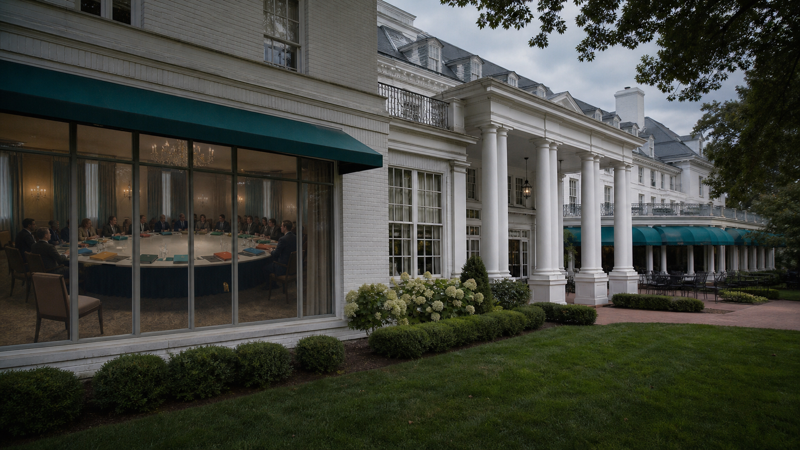
The Carolina Inn is more than a hotel with a Chapel Hill address. The venue’s own history says the property was donated to the University of North Carolina in 1935. That supports saying the ministerial is taking place in a UNC-linked Triangle setting.
It does not support saying UNC is co-hosting, setting the agenda, negotiating text or endorsing an outcome.
- The Commerce advisory names federal hosts, not UNC.
- The Town of Chapel Hill notice addresses public safety and transportation effects but identifies no local policy role.
- The European Commission announcement confirms international participation and planned diplomatic meetings but names no Triangle institution or local technology figure as a policy counterpart.
No public local policy role was located in the official sources reviewed on Aug. 31. That finding does not prove that Triangle people were excluded from working sessions, private consultations or side meetings. It shows that the local role has not been made visible in the main public records available before the event.
The meeting includes real diplomacy
The European Commission says its executive vice president, Henna Virkkunen, will participate in discussions on AI, emerging technology, supply chains, skills, science and investment. It also announces bilateral meetings with Kratsios and ministers from Japan, Türkiye, India and Mexico.
That is evidence of substantive diplomatic activity around the Chapel Hill meeting. It sharpens the local question: if foreign governments are using the event for AI and technology diplomacy, which Triangle actors, if any, are inside the rooms where policy language or follow-up commitments are being shaped?
Secondary reporting points to another possible local significance: access and prestige. Reuters, republished by Investing.com, reported that national technology executives including OpenAI CEO Sam Altman and NVIDIA CEO Jensen Huang are scheduled to appear. It attributed a light-touch U.S. policy proposal to an unnamed White House official.
Those reports deserve scrutiny, but they do not establish a Triangle negotiating role. A national CEO appearing or speaking in Chapel Hill does not show that a local company, university researcher, civic technologist or government official helped write policy text. It also does not show that the Triangle will retain a research partnership, investment or policy obligation after the meeting.
A Chapel Hill agreement is possible
There is precedent for a G20 digital ministerial producing a place-named policy document. The official G20 Maceió Ministerial Declaration on Digital Inclusion for All, adopted in Brazil in 2024, included commitments and principles on inclusive and sustainable AI development.
The process matters. Brazil’s official G20 archive places the declaration under its Digital Economy Working Group, says the group reached consensus after four years without declarations, and publishes related AI mapping and readiness documents.
The U.S. advisory for Chapel Hill says ministers will seek to identify principles, but it discloses no comparable working-group record, technical report, draft declaration or named outcome document. That does not rule out an agreement. It makes any confident prediction of a “Carolina Inn AI policy” speculative before the meeting produces text that readers can evaluate.
The practical test is whether the ministerial produces an identifiable document with language, participating governments, status and follow-up obligations: a declaration, chair’s statement, principles, memorandum, communiqué or outcome summary.
What to look for next
The records that would change the current judgment are specific:
- a full participant roster showing Triangle universities, companies, local governments or civic organizations in working sessions;
- an agenda showing Triangle institutions helping frame AI, supply-chain or science-policy discussions;
- a draft or final outcome document naming Chapel Hill, the Carolina Inn or a Triangle institution in connection with policy language;
- bilateral-meeting readouts that include a Triangle actor, research partnership, investment commitment or implementation role;
- post-event records showing who contributed to text, which governments accepted it and what follow-up mechanism exists.
The Triangle is hosting a real G20 technology ministerial with AI on the agenda. The public evidence available before the event does not yet show that the Triangle is shaping its policy outcome.