
Give residents something they can check
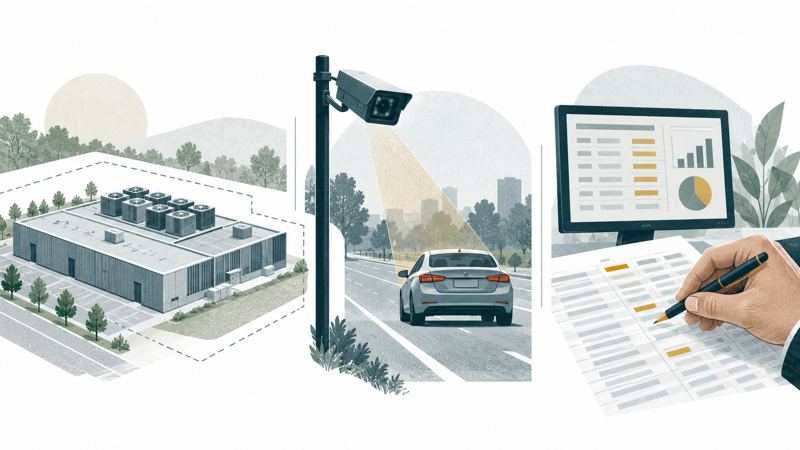
Raleigh residents can now read the proposed limits of a data-center pause. Apex residents still do not know what their town will decide about Flock cameras. And the State Auditor’s office describes an AI workflow whose claimed time savings remain unverified in the public records we checked.
Those are different stages of public scrutiny. The useful question across this week’s reporting is how much each institution has made possible for residents to check.
Raleigh’s proposed data-center moratorium now has terms residents can examine before council acts. The draft ordinance identifies development applications that would pause, exemptions tied to size, power demand and use, and a work schedule for developing regulations.
Publishing those details changes the debate. Residents can question an exemption or a deadline instead of arguing over an undefined pause. The draft does not establish that council has adopted the moratorium or that the proposed studies are complete.
In Apex, the questions about Flock cameras and outside access to their data remain open. WRAL’s Avery Davis and Lance Wilhelm report that the Public Safety Committee reached no decision on October 1, wanted more answers and will discuss the system again December 3.
Our reporting placed Apex alongside communities that have ended contracts, changed vendors or sought tighter controls. Those different choices make the local evidence more important: residents need to know which controls Apex actually uses and what its audits show. Another meeting leaves time to supply those answers.
The State Auditor’s AI claims face a different test. The sources we checked support a described process of software flagging transactions for human investigation, alongside funding authority and staffing plans. They do not independently verify the claimed time savings, accuracy or full costs.
Human review is a meaningful part of that process. It also takes time and money. Measuring only the initial scan would leave out work needed to distinguish a suspicious transaction from an innocent one. The office’s account gives us a workflow to examine; validating its claimed gains requires records of the work through completion.
Next week in the Triangle
Join one if you can:
- Monday, October 5, 6 to 8 p.m.: Dean Peters, Productside principal consultant and trainer, is the announced speaker for Triangle Startup Collective’s AI-Augmented Product Discovery & Ideation Validation at Raleigh Founded, 509 W. North St., Suite 224, Raleigh. The session focuses on testing product ideas with AI.
- Tuesday, October 6, 7 p.m.: Raleigh City Council will hold its public hearing on the proposed data-center moratorium in Council Chamber, 222 W. Hargett St., Raleigh. Speakers must attend in person and register by 3 p.m. Friday, October 2, through the city’s hearing registration process.
- Thursday, October 8, 4:30 to 6:30 p.m.: NC TECH Brews + Bytes meets at Pendo HQ, 301 Hillsborough St., Suite 1900, Raleigh. Meet regional technology peers; register in advance.
- Friday, October 9, 10 a.m. to 2 p.m.: NC TECH and Kramden Institute will hold a Digital Drive at the NC TECH office parking lot, 4000 Westchase Blvd., Raleigh. Bring listed accepted computer equipment for donation.
Who should we know?
Introduce us to someone making a consequential Triangle technology decision, or send a tip about what they are doing.