
Questions need a usable route
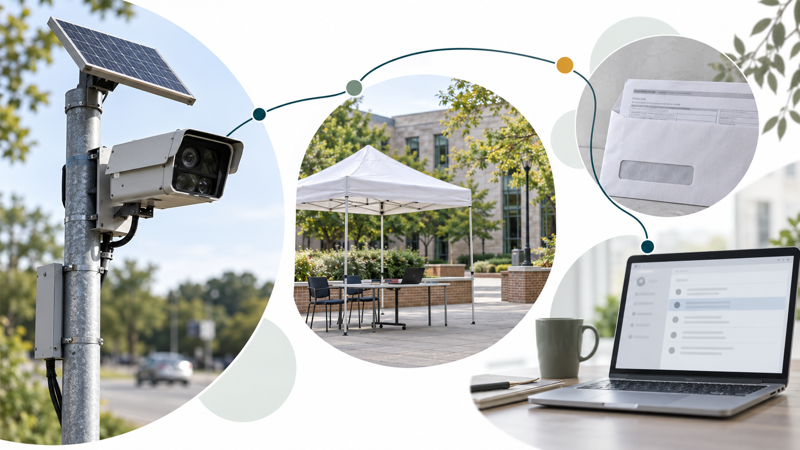
Triangle institutions should give affected people a usable way to ask questions, get a response and test the answer against records. The responsible office should explain what it considered and give people records that let them assess the answer. An objection won’t always change the result. It should receive a response.
UNC-Chapel Hill’s reported Flock access change leaves outside access possible. According to the police chief’s account reported by The News & Observer, automatic sharing has reportedly been turned off, while outside agencies may still make direct requests to UNC Police. The settings, written approval standards and audit results have not been independently verified in public materials. UNC should explain how people can question an access decision, alongside the approval criteria and aggregate audit findings that let them assess the gate it describes.
At NC State, the question is who gets a campus stage and how others can seek one. The university promoted and scheduled Google’s Gemini visit while identifying free course access as a benefit of its AI Accelerator relationship. The university describes that training benefit; Google’s general training terms differ in ways whose applicability to NC State remains unresolved. The available materials do not establish an event-specific payment, agreement, space charge or waiver. NC State should explain the exchange and offer eligible organizations a usable way to seek consideration. That is not a right to identical treatment. It is a way to understand the criteria for a public university’s choices.
Raleigh’s State Board of Elections faces a different task with its planned mailing to 1,392 registered voters following federal SAVE citizenship checks. Delivery and recipients’ actual workload remain unverified. The Board’s announcement describes the planned mailing. Its specimen letter says a notice does not cancel a registration. Its agreement with federal officials describes opportunities to appeal and correct records before a final decision. That existing route is different from the recommendation here: publish aggregate response times, outcomes and available help, so recipients and the public can test whether the correction process works without exposing private records.
UNC’s intended Campus Safety Update puts another consequential judgment with UNC Police and University Communications and Marketing, which will decide whether a contained serious incident merits a MassMail message. The FAQ describes an intended process, not a verified safety improvement or fixed response-time promise. Brianna Atkinson of WUNC reported that representatives of the Black Student Organization Coalition welcomed the added channel as useful while raising broader concerns about Black students’ safety and belonging. Those concerns, reported by WUNC, sharpen the point: people affected by these calls need a meaningful way to question them and see what follows.
A published rule should lead to someone who will answer for it.
Next week in the Triangle
- Monday–Tuesday, October 19–20: All Things Open brings open-source workshops and conference sessions to the Raleigh Convention Center. Workshops start at 9 a.m. Monday, and the main program starts at 8:45 a.m. Tuesday. Registration is required; see the schedule for security, AI, accessibility and community-governance sessions.
- Thursday, October 22, 5–7 p.m. EDT: Councilmember Edward Gray hosts public-safety and license-plate-reader office hours at Apex Town Hall, 73 Hunter Street. Bring questions and feedback; no formal staff presentation is planned.
- Friday, October 23, 2–4 p.m. EDT: NC State’s cyber-physical and robotic systems workshop is free and open to the public at Research Building IV, 909 Capability Drive, Raleigh. Visitors can see new lab space and research posters on robotics, sensing, edge computing and wearable health technology.
Who should we know? Introduce us to someone making a consequential Triangle technology decision, or send a tip about what they are doing.